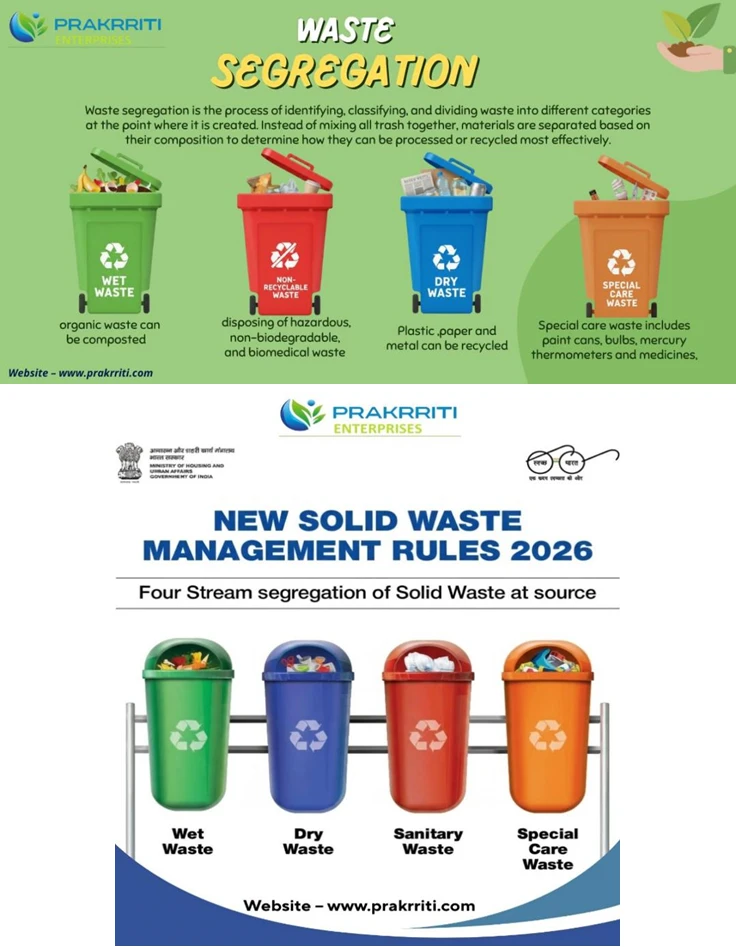
The Ministry of Environment, Forest and Climate Change (MoEF&CC) has notified the Solid Waste Management Rules, 2026, which will come into full effect from April 1, 2026. Replacing the decade-old 2016 framework, these rules shift the focus from simple collection to a "Circular Economy" model.
Here are the critical points every business and local body needs to know:
Mandatory Four-Stream Segregation
The most visible change is the transition from two-way (wet/dry) to four-way segregation at the source. Waste must now be separated into:
Wet Waste: Biodegradable kitchen and garden waste.
Dry Waste: Plastic, paper, metal, glass, and wood.
Sanitary Waste: Diapers, sanitary pads, and hygiene products (must be wrapped securely).
Special Care Waste: Domestic hazardous items like batteries, bulbs, paint cans, and expired medicines.
Stricter Definition of Bulk Waste Generators (BWGs)
The rules now clearly define who is responsible for managing their own waste. An entity is classified as a BWG if it meets any of these criteria:
Area: Built-up area of 20,000 sq. meters or more.
Water Usage: Consuming 40,000 litres of water or more per day.
Waste Volume: Generating 100 kg or more of waste per day.
Includes: Housing societies, malls, hotels, hospitals, and government offices.
Digital Monitoring & Mandatory Registration
Following the logic of EPR (Extended Producer Responsibility), the new rules introduce EBWGR.
BWGs must process wet waste on-site through composting or bio-meth nation.
If on-site processing is impossible, they must obtain EBWGR Certificates from authorized waste processing facilities to prove their waste was handled scientifically.
Extended Bulk Waste Generator Responsibility (EBWGR)
To ensure transparency, a Centralized Online Portal will be launched.
All BWGs, local bodies, and waste processors must register on this portal.
Annual Returns must be filed by June 30th every year, detailing the quantity of waste generated and the mode of processing.
"Polluter Pays" – Environmental Compensation
The 2026 rules move from "advisory" to "deterrence."
Environmental Compensation (EC) will be levied for non-compliance, such as improper segregation or operating without registration.
Local bodies will face higher fees for dumping unsegregated waste into landfills, making "dumping" the most expensive and least preferred option.
Integration of Refuse-Derived Fuel (RDF)
To promote circularity, industrial units (like cement plants) are now mandated to substitute a portion of their fossil fuels with RDF (fuel made from non-recyclable dry waste). The substitution rate starts at 6% and will scale up to 15% over six years.
How Prakrriti Enterprises Can Help
As experts in Solid Waste Management and Wastewater Treatment, we are ready to help your facility transition to these new standards. From setting up on-site organic waste converters to managing your EBWGR compliance and digital reporting, we ensure your business stays ahead of the April 2026 deadline.
Contact us today for a compliance audit!

